

People from all over the United States converged on Cape Canaveral, Florida to watch Artemis II launch on April 1, 2026.
The Artemis missions are a series of progressively complex missions to “explore more of the Moon for scientific discovery, economic benefits, and to build on the United States’ foundation for the first crewed missions to Mars.
Artemis I was an unmanned Orion spacecraft launched on the Space Launch System rocket and traveled thousands of miles beyond the Moon, over the course of about a three-week mission.
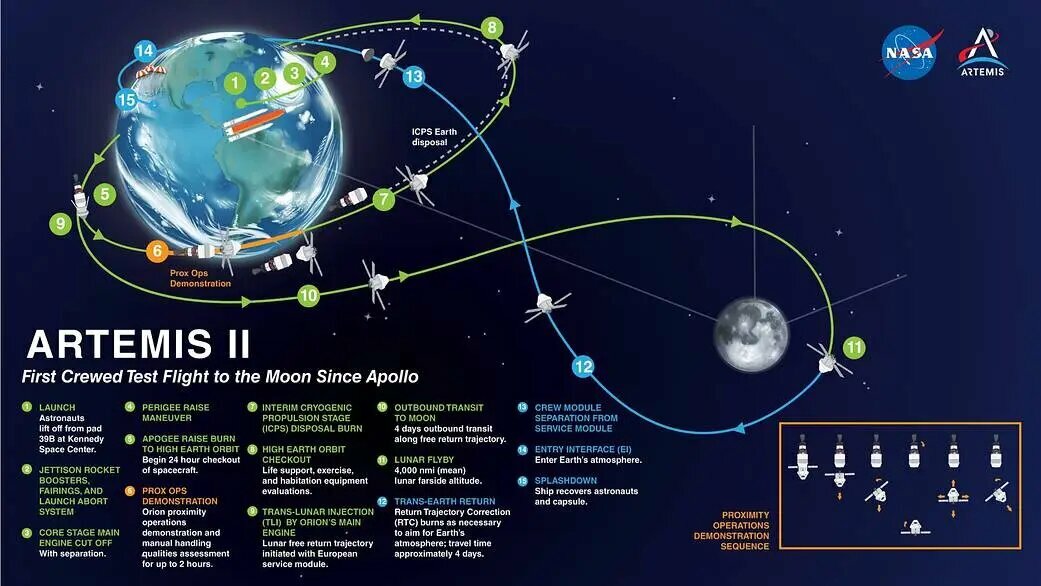
Artemis II is a manned operation “that will perform a planned multi-hour lunar flyby on Monday, April 6, the astronauts have taken photographs and provide observations of the Moon’s surface as the first people to lay eyes on some areas of the far side. Although the lunar far side will only be partially illuminated during the flyby, the conditions should create shadows that stretch across the surface, enhancing relief and revealing depth, ridges, slopes and crater rims that are often difficult to detect under full illumination. Crew observations and other human health scientific investigations during the mission, such as AVATAR, will inform science during future Moon missions.
Following a successful lunar flyby, the astronauts will return to Earth and splash down in the Pacific Ocean.
As part of Golden Age of innovation and exploration, NASA will send Artemis astronauts on increasingly difficult missions to explore more of the Moon for scientific discovery, economic benefits, and to build on our foundation for the first crewed missions to Mars.
“Artemis II is a test flight, and the test has just begun. The team that built this vehicle, repaired it, and prepared it for flight has given our crew the machine they need to go prove what it can do,” said NASA Associate Administrator Amit Kshatriya. “Over the next 10 days, Reid, Victor, Christina, and Jeremy will put Orion through its paces so the crews who follow them can go to the Moon’s surface with confidence. We are one mission into a long campaign, and the work ahead of us is greater than the work behind us.”
The astronauts aboard this manned flight are Commander Reid Wiseman pilot Victor Glover, mission specialist Christina Koch from NASA, and mission specialist Jeremy Hansen from the Canadian Space Agency are NASA’s first manned flight test around the Moon to confirm today’s capacity for humans to explore deep space and long-term exploration and science on the Moon’s surface.
Information and photos from nasa.gov